Maine is known for the richness and diversity of its ecosystems—spanning coastal regions, boreal forests, and vast inland waterways. This same diversity is reflected in its people and communities, from the bustling city of Portland to the working waterfronts of its coastal towns and the northern communities built around the lumber industry. The University of Maine System (UMS) Nursing programs mirror this geographic and cultural variety through four distinct campuses: the University of Southern Maine in Portland, the University of Maine at Augusta, the University of Maine at Fort Kent, and the flagship University of Maine in Orono.
Dr. Shannon Gauvin, Director of Nursing and Program Coordinator at the University of Maine at Augusta, attended the Healthcare Simulation Essentials: Design and Debriefing (HSE) course at the Center for Medical Simulation (CMS) in Boston in April 2023. During that week, she envisioned a unified effort to elevate the quality of simulation across all UMS nursing campuses and to align practices with the Healthcare Simulation Standards of Best Practice© (HSSBP).
Recognizing the opportunity to foster system-wide excellence, the Applied Learning for Performance and Safety (ALPS) team at CMS partnered with UMaine Nursing to help realize this vision. The challenge was to strengthen collaboration and standardization while honoring each campus’s unique culture and resources. The engagement formally began in August 2024 with the first Healthcare Simulation Essentials (HSE) course offered to nursing faculty across the system as a targeted faculty coaching intervention. Several faculty members who had previously completed the HSE course (including Lisa Heald, Shannon Gauvin, and Erin Bellaire) supported this initiative and expanded their own expertise in the process.
Following this foundational work, the Simulation Education Steering Committee (SESC) was established, representing all four campuses and initially led by Dr. Mary Fey and then by Shannon Gauvin and Liz Guerdin. Early priorities centered on faculty development, and workshops were offered on topics such as:
- From Feedback to Coaching With Good Judgment
- SimZones as a Framework for Simulation Curriculum Development
- Implementation of Supportive Assessment: Formative and Summative Assessment in Simulation
The second HSE course was held in May 2024, drawing 16 faculty participants and further strengthening a shared language and vision for simulation-based education.
With a focus on standardization, the SESC made two pivotal decisions. First, all campuses adopted the Simulation Effectiveness Tool (SET) to collect student feedback on simulation experiences. Although the mechanisms for data collection vary across campuses, this unified metric now allows for shared analysis and benchmarking. Second, the committee committed to a deliberate, phased implementation of the HSSBP, beginning with the “Core Four”: Debriefing, Preparation & Briefing, Facilitation, and Professional Integrity.
The SESC undertook the task of standardizing Preparation and Briefing processes across campuses. A subcommittee developed a suite of resources tailored to varying levels of faculty experience. Through surveys and collaborative design sessions grounded in the concept of Readiness Planning, representatives gathered insights into local practices and created harmonized documents to support consistent, high-quality prebriefing and preparation across the University of Maine System.
These included two versions of a Prebriefing Script—a concise checklist for experienced facilitators and a more detailed guide with sample language for newer faculty—and a Comprehensive Faculty Guide to Prebriefing, outlining the theoretical and practical foundations of effective prebriefing in simulation-based learning. Content from this guide will inform a new Faculty Professional Development Online Course currently under development.
The Faculty Professional Development Online Course standardizes the onboarding of new faculty as they learn to facilitate simulation-based learning experiences in alignment with INACSL’s core four simulation standards, plus the Good Judgment Approach. Using the Readiness Planning process, core learning outcomes were identified, and programs were designed to target and meet these outcomes. This process was integrated with the micro-credentialing process at UMaine so that faculty would have a tangible reward at the end of the course that can be added to their CV. All new faculty will be required to take the course, again strengthening the standardized approach to simulation across the campuses.
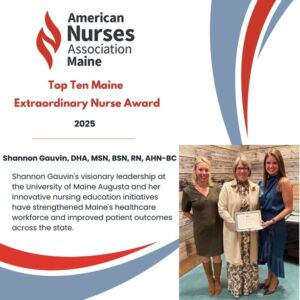
CMS nursing faculty specific workshops on UMS campuses have totaled 600 learning hours across more than 50 faculty. 32 nursing faculty have been trained in the Healthcare Simulation Essentials: Design & Debriefing Program with another 18 coming in 2026. As a culmination of this work, the University of Maine at Augusta nursing program will be applying for official INACSL accreditation in March 2026. Additionally, in 2025 the American Nurses Association named Shannon Gauvin one of the top ten nurses in Maine.
This ongoing partnership between the UMS Nursing programs and the ALPS team at CMS illustrates how a unified vision, grounded in evidence-based standards and collaborative faculty development, can transform simulation education across a diverse, multi-campus system.
Learn more about ALPS here or contact Mary Fey for information on ALPS for Schools.