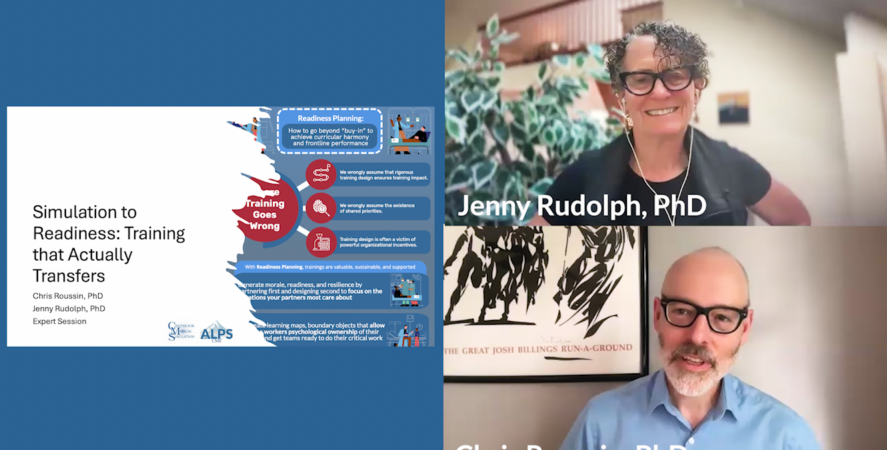
“There should be no more simulation programs. There should be READINESS programs.” Jenny Rudolph and Chris Roussin team up to show how simulation programs can make themselves essential to their larger organizations:
This video podcast was originally presented as a keynote at SimGlobe 2026 in Bengaluru, India, as well as at the Beth Israel Lahey Simulation Symposium in Boston, Massachusetts.
Listen & Subscribe: https://podcasts.apple.com/us/podcast/the-center-for-medical-simulation/id1279266822
Readiness Planning Paper Link: https://pmc.ncbi.nlm.nih.gov/articles/PMC11667836/
Get your teams ready with CMS-ALPS: https://harvardmedsim.org/alps-applied-learning-for-performance-and-safety/
Full Episode Transcript Below:
[00:00:00] Jenny Rudolph: Thank you so much for having me, Jenny Rudolph, and Chris Roussin join you at SimGlobe 2026. I’m the Director of Innovation at the Center for Medical Simulation in Boston, and a lecturer at Harvard Medical School. And Chris Roussin and I are going to be talking with you today about how to get simulation to a place where it actually transfers and has an impact on care.
[00:00:29] Chris and I have both worked over the last five or 10 years or more across the Harvard system trying to figure out, how do we get people ready to do the jobs they do? But Chris is going to be the one really sharing the story with us about how do we get ready. Chris?
[00:00:46] Chris Roussin: Hello, global sim people. My name is Chris Roussin.
[00:00:50] I work with Jenny at the Center for Medical Simulation. I’m the senior director in charge of our ALPS team, Applied Learning for Performance and Safety.
[00:00:59] Jenny Rudolph: Chris, your work on readiness plans and sim zones has been a real game changer for me personally over the last seven years as we’ve been working together.
[00:01:10] It completely changed how I approach partnering with people and designing the simulations that I do. I wonder if you could just get us started with what all is behind this idea that lets us really do simulation that transfers.
[00:01:27] Chris Roussin: Thank you so much, Jenny. That’s an honor to hear you say that, and, you’ve impacted my practice very, very deeply.
[00:01:32] Thank you for that. Um, it, it came out of necessity, these innovations, Jenny. you know, I’d been hired at Boston Children’s Hospital, given the mandate to make simulation successful there. We were doing a lot of simulation, but we were having a lot of struggles, and we were noticing that we weren’t accomplishing our goals as clearly as we wanted to.
[00:01:51] We didn’t have goals that were set as clearly as we wanted related to simulation, and it was, it was a pretty dire situation in, in, in my leadership role during that time. So, you know, what did we do to help in that moment, and, and what did I and the team do in that moment to, make things better for ourselves?
[00:02:09] You know, we’re going to talk about that today. What we learned was that simulation was an engine of learning and an engine of readiness in the hospital, and it was not a headline. Any time we went to someone and said, “You should be doing simulation. We’re happy to help you do simulation,” we realized that was not totally inspiring for them, and we needed a different story.
[00:02:27] So we needed to find out what they were trying to accomplish on a daily basis and then connect what simulation offered to that. Um, and the focus was always on clinical readiness, and that was when we started to have great success at Boston Children’s Hospital. We aligned with strategic priorities. It was not unusual to meet with the president of the hospital, to, to meet with the chiefs of divisions, and to do that very, very regularly in addition to the front line, and to understand what people thought was important and make sure that what we were doing was aligned with that, and to reinforce that regularly, and ultimately to align with operations over education.
[00:03:03] Even though education’s very important and the forces of education are important in the hospital, aligning with operations is essential for the success of simulation. We have to be influencing everyday clinical performance in addition to certifications and education credits and other things that simulation supports.
[00:03:23] Jenny Rudolph: When you say align with operations, what you mean is what are the clinical readiness goals for, for example, pediatric orthopedics, or what is the clinical readiness goal for the thoracic surgery program? And even though people need education to get ready, if you don’t know what they’re trying to accomplish, you can’t help them.
[00:03:45] Have I gotten that right?
[00:03:47] Chris Roussin: You got that perfectly right. Yeah. If, if you ask the leaders of the hospital, they say, “We take care of patients every day.” And if you ask them about simulation, if they say, “Simulation does education,” that’s a problem. If they say, “Simulation helps us take care of patients every day-” Now we’re doing something right.
[00:04:05] We have a paper that we would love to invite you to read, and it’s called Readiness Planning: How to Go Beyond Buy-In to Achieve Curricular Harmony and Frontline Performance. You can scan this code to get to that paper, and it’s published in Advances in Simulation.
[00:04:19] Jenny Rudolph: You’ve said that we should potentially move away from positioning simulation as education and think about somehow aligning it with clinical operations.
[00:04:31] And I know for me, when you first started talking to me about that, I thought, “What the heck is he talking about?” So could you help us understand where does simulation fit into today’s healthcare in your view?
[00:04:44] Chris Roussin: That’s the question, where does simulation fit into today’s healthcare? And I don’t think we’ve defined that.
[00:04:49] It, it’s really open. it’s an open question to be solved, and hospital leaders are not clear on that answer, and, and simulation leaders around the world are really not clear on where simulation exactly fits into today’s healthcare with all of the crises and struggles that we have. Simulation has a bit of a Wheaties problem.
[00:05:07] There was this famous breakfast cereal called Wheaties, and they featured famous athletes on their box, and it was called The Breakfast of Champions. And in the commercials they said, “Eat your Wheaties. Michael Jordan eats his Wheaties. You should eat your Wheaties. He does it, so you should do it.” And I think simulation has a bit of that same problem.
[00:05:26] When I came to healthcare, um, there were people saying, “Yeah, you should do simulation. The smart hospitals do it. The smart health systems do it. Stanford does it. Harvard does it. Smart people do simulation. It’s so obvious. You should do it. You should practice away from patients. You should make mistakes in simulation and not with patients.”
[00:05:43] But really, that wasn’t a clear enough value proposition for leaders to completely understand, and that became a real problem. And that led to weak executive support, and that led to people having to kind of beg to keep simulation programs and keep their square footage and keep the simulation happening near the hospital Part of the problem there was that simulation curriculum, when you looked at it, was a little bit of a magic box.
[00:06:07] People would say, “We’re doing simulations. We’re simulating this kind of work today. We’re going to the sim lab.” And the way we referred to simulation curricula was really not specific enough. Why are you in simulation? What is the skill you’re learning that day? What is the scenario that you’re practicing?
[00:06:23] What is your goal for that practice and rehearsal? Do you view it as rehearsal? Do you view it as training? And a lot of that was underspecified. So it really made simulation hard to defend as an asset, um, and as an organization within the hospital, and it made it unclear as to how it blended with the hospital.
[00:06:42] The world that we ended up creating was really dominated by a lot of low-frequency, kind of high-drama simulation training related to emergencies. But it wasn’t– it didn’t happen often enough to really influence how people train. You can’t train once a year and, and get better at teamwork, so it just really didn’t make sense.
[00:07:01] And so that led to minimal appreciation of simulation, um, very uneven understandings about what simulation could do, and all of that became a big problem, and that’s the simulation world that we really created.
[00:07:13] Jenny Rudolph: So Chris, to help us pivot from low-frequency, high-impact events to being ready for the procedures we do every day, the conversations we have to have with families, or goals of care, or end of life, you’ve argued that we really need a different starting point.
[00:07:32] We need a different center. And I would appreciate your sharing what that is from your perspective.
[00:07:39] Chris Roussin: Yeah, Jenny, we’ve, we’ve really given it away already, which is good. We’ve talked about this word readiness, and really, I believe the real crisis in healthcare is related to unreadiness, and that is a perfect center for simulation.
[00:07:51] Unreadiness and creating readiness where there used to be unreadiness. And what do we mean by unreadiness? You have all these different places in the hospital and in the healthcare system, and each of them has their massive unreadiness challenges. The packed, waiting lines in the emergency department, too many patients in the intensive care unit, new technology, new clinical staff who aren’t ready for what they need to do, violent patients in the medical wards, the NICU, patient transport, operating rooms, labor and delivery, primary care.
[00:08:22] They all have their very well-known unreadiness challenges. We can look at all the different types of people in the healthcare system and, and the obvious unreadiness related to all of these folks in healthcare. Getting those people ready at the beginning of their careers, at the beginning of a shift, to work in teams, to integrate well, to be successful so they don’t leave their jobs.
[00:08:45] And then all of the things that we need to do, being ready for procedures, communicating with other professionals and patients, families, discharging patients, recovering from conflicts, clinical decision-making, patient transfers. All these things where there’s so much unreadiness related to these things in healthcare.
[00:09:03] And, and focusing on these unreadiness aspects and turning them into readiness is just a perfect focus for simulation.
[00:09:10] Jenny Rudolph: And Chris, um, the term that you’ve used additionally to unreadiness that I’ve found very potent in focusing my efforts is, what are our situational vulnerabilities?
[00:09:22] Chris Roussin: Hmm.
[00:09:23] Jenny Rudolph: Yeah. So, my team is not ready to do point-of-care ultrasound-guided central venous line placement.
[00:09:29] It takes us too long. We have too high of an infection rate. That is a situational vulnerability. Our team is not ready to manage an aggressive or combative patient. Too often, people are hurt or patients are hurt. That is a situational vulnerability. And what I think you’ve been arguing successfully is if we can help our clinical partners executive leaders and others address these areas of clinical vulnerability, all of a sudden they’re way more interested in what we have to offer.
[00:10:04] And so could you talk a little bit about this simulation readiness system rather than simulation?
[00:10:12] Chris Roussin: Yeah. So the ra- the radical version of this idea, Jenny, is there should be no more simulation programs. They should be readiness programs. Anytime you’re going to do simulation, you should start with a readiness plan.
[00:10:23] And really, you should know what that team is trying to be ready for, and now you know what to do with simulation. And it’s, it’s a very clear connection between those things. And so every simulation effort is driven by something that’s real, that’s an operational need, that’s a readiness need. Let’s, let’s look at a case.
[00:10:41] And I liked how you said situational vulnerability. Here’s one. Newly hired nurses are… We are worried that they will be around deteriorating patients because they may not know how to identify them and how to escalate care. And this happens in every hospital everywhere in the world. This is one of the stories we hear over and over and over again.
[00:11:02] It’s difficult to identify a deteriorating patient. It’s difficult to escalate care, especially as a new clinician. And so if we know that that’s happening, we look around the hospital, we notice that there’s safety events happening. New nurses are leaving their jobs because these situations are too stressful.
[00:11:19] The senior nurses are getting exhausted because they’re the ones handling everything. People are getting mad at each other. There’s lots of conflict. All of this is really a signal to initiate readiness planning. This is our tool, so we really sit down with all the people involved, build a readiness plan, and center it around a, a readiness kind of title.
[00:11:40] We need new nurses to be ready to identify clinical deterioration and execute rapid escalation procedures on the inpatient floor. And so there’s our guiding readiness statement. That becomes the title of a readiness plan. And here is that readiness plan, and this, this is featured in our paper, so if you got the QR code, you can go look at the readiness plan.
[00:12:02] But it has three elements to it. Right in the center, what’s the situational readiness need? We need nurses to be able to identify that deteriorating patient and escalate care. On the left-hand side, we have our skill readiness need. Those are all each of the micro skills that are inside of that situation that we need in order to capably handle that situation.
[00:12:22] And they’re all listed out, and yes, there are many of them, and they’re all listed out. And, and then column three is our continuous readiness routines. What are the things we need to do so that we can stay ready and improve our readiness over time? So debriefing after something really happens, doing simulation, okay, to, to learn skills and practice situations, testing of our process over time, and that’s, that’s a really comprehensive example of a readiness plan, Jenny How do we turn it into sim, I think is the big question.
[00:12:52] We have a system called Sim Zones that delineates different types of simulation. But basically, if you have a readiness plan, you can kind of pick items out of that readiness plan and match them to simulation curriculum, and make sure that you’re doing the right thing with simulation to accomplish what you want, which kind of readiness that you want, whether it’s skills or situations in that moment.
[00:13:15] Jenny Rudolph: And Chris, the clarity of the Sim Zones approach is that it names this idea that we can have staged learning. We don’t have to throw people right into the deep end of the pool. We can start them in the shallow end. We can move them through the middle of the pool to the deep end. I know we all do that frequently with procedural teaching, psychomotor practice, et cetera.
[00:13:41] We can use that staged learning approach for teamwork skills, conversation skills, and procedural skills. So Chris, to wrap us up here, what are the next couple steps that we should take? What’s our action, what’s our call to action if we want to apply this?
[00:13:59] Chris Roussin: You know, we encourage you to stop just doing simulation or having mannequins and k- thinking about where to aim them, and start with partnerships with the clinicians, whether it’s in your department or across the hospital, across the health system.
[00:14:13] Have a cup of coffee. Have a nice dessert.
[00:14:15] Jenny Rudolph: Actually, Chris, probably chai would maybe be the first choice there.
[00:14:18] Chris Roussin: Probably chai in this case. Yeah. Yes. Yeah. And have something delicious. Have a great conversation, and talk about what are they worried about. What’s, what are the situational vulnerabilities in their hospital, in their department?
[00:14:31] Make a readiness plan. It can be simple. It doesn’t have to be a fancy one like the one we showed you. We want to get people ready to do these very specific things, and now you know where to aim simulation. You can create simulation-based learning to accomplish those readiness goals.
[00:14:47] Jenny Rudolph: And Chris, the phrase that you came up with that I really loved in the readiness plans paper is, “We are partners first and designers second.”